

How To Find The 25th Percentile Of A Data Set
In this tutorial, y'all'll learn how to use the Pandas quantile office to calculate percentiles and quantiles of your Pandas Dataframe. Being able to calculate quantiles and percentiles allows you lot to easily compare data against the other values in the data. Y'all'll learn how to employ the Pandas quantile method, to summate percentiles and quartiles, as well as how to use the dissimilar parameters to modify the method's behaviour.
Past the end of this tutorial, yous'll take learned:
- Why y'all may want to summate a percentile
- How to summate a unmarried percentile of a Pandas column
- How to calculate multiple percentiles or quartiles of a Pandas cavalcade
- How to calculate percentiles of an entire dataframe
- How to modify the interpolation of values when calculating percentiles
The Quick Answer: Utilize Pandas quantile to Calculate Percentiles
What is a Percentile?
A percentile refers to a number where certain percentages fall below that number. For case, if we summate the xcth percentile, and so we return a number where ninety% of all other numbers fall below that number. This has many useful applications, such as in education. Scoring the in 90thursday percentile does not mean you lot scored 90% on a test, just that you scored improve than 90% of other examination takers.
A quartile, nevertheless, splits the data into four equal chunks of information, split up into 25% values. The quartile, therefore, is really splitting the information into percentiles of 0%, 25%, 50%, and 75%.
Existence able to calculate a percentile has many useful applications, such as working with outliers. Because outliers accept a big effect on machine learning models that may skew their performance, you may desire to be aware of them. For example, y'all want want to know how many values fall in and outside of the 5th and 95th percentile to see how much skew of your data to look.
Allow's get started with learning how to calculate a percentile in Pandas using the quantile role.
Loading a Sample Pandas Dataframe
Permit'due south start off by loading a sample Pandas Dataframe. If you lot have your ain information, experience gratis to use that. However, if y'all want to follow along with this tutorial line past line, copy the code beneath to generate our dataframe:
# Loading a Sample Pandas Dataframe import pandas as pd df = pd.DataFrame.from_dict({ 'Student': ['Nik', 'Kate', 'Kevin', 'Evan', 'Jane', 'Kyra', 'Melissa'], 'English': [90, 95, 75, 93, 60, 85, 75], 'Chemistry': [95, 95, 75, 65, fifty, 85, 100], 'Math': [100, 95, 50, 75, xc, 50, fourscore] }) print(df.head()) # Returns: # Student English language Chemical science Math # 0 Nik 90 95 100 # 1 Kate 95 95 95 # 2 Kevin 75 75 50 # three Evan 93 65 75 # 4 Jane 60 50 90 Nosotros can see that we've loaded a Pandas Dataframe covering pupil'due south grades. We have a unmarried 'object' column containing our student names and three other numeric columns containing students' grades.
Now, let'southward dive into understanding how the Pandas quantile method works.
Pandas Quantile Method Overview
The Pandas quantile method works on either a Pandas series or an entire Pandas Dataframe. By default, information technology returns the 50th percentile and interpolates the information using linear interpolation.
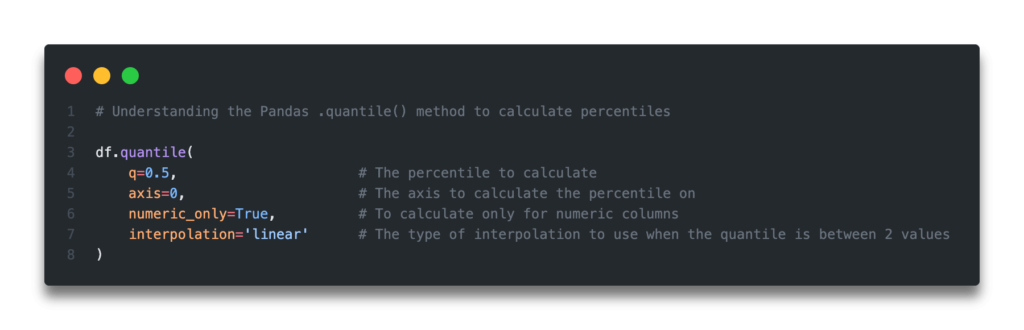
Permit's take a look at what the method looks like and what parameters the quantile method provides:
# Agreement the Pandas .quantile() method to calculate percentiles df.quantile( q=0.v, # The percentile to calculate centrality=0, # The centrality to calculate the percentile on numeric_only=Truthful, # To summate just for numeric columns interpolation='linear' # The type of interpolation to use when the quantile is betwixt 2 values )
Allow'south take a look at the different parameters that the Pandas quantile method offers. The default arguments are provided in square [] brackets.
-
q=[0.5]: a float or an array that provides the value(s) of quantiles to calculate -
axis=[0]: the centrality to summate the percentiles on (0 for row-wise and one for cavalcade-wise) -
numeric_only=[True]: is set up toFalse, calculate the values for datetime and timedelta columns equally well -
interpolation=['linear']: if quantiles exist between two values, how to interpolate the values
At present that you lot've learned about the dissimilar arguments available, let'south leap in and summate a percentile for a given column.
Use Pandas Quantile to Calculate a Single Percentile
In this section, you'll learn how to summate a unmarried percentile on a Pandas Dataframe column using the quantile method. We can simply use the method to a given column and the percentile is returned. Let's see what this looks similar:
# Generate a single percentile with df.quantile() print(df['English'].quantile()) # Returns: 85.0
Past default, Pandas volition use a parameter of q=0.5, which volition generate the 50th percentile. If we wanted to, say, calculate a 90th percentile, we can laissez passer in a value of q=0.9 in to parameters:
# Generate a single percentile with df.quantile() print(df['English'].quantile(q=0.ix)) # Returns: 93.8
We tin meet that by passing in merely a unmarried value into the q= statement that a single value is returned. But what if nosotros wanted to calculate a number of percentiles for a unmarried Pandas column? This is what you'll learn in the next section.
Use Pandas Quantile to Calculate Multiple Percentiles
There may be many times that you want to summate a number of unlike percentiles for a Pandas column. The q= argument accepts either a single number or an array of numbers that nosotros want to summate.
If nosotros wanted to calculate multiple percentiles, we simply pass in a list of values for the different percentiles we want to calculate. Permit'southward see what this looks similar:
# Generate multiple percentiles with df.quantile() print(df['English'].quantile(q=[0.1, 0.9])) # Returns: # 0.one 69.0 # 0.ix 93.8 # Proper name: English language, dtype: float64
This returns a Pandas series containing the different percentile values. If we wanted to access a single value in this series, we can simply access it past selecting its index. Let's meet how we can select the 90th percentile in our series:
# Generate multiple percentiles with df.quantile() and selecting i print(df['English'].quantile(q=[0.ane, 0.9])[0.9]) # Returns: 93.8
This is a helpful method if yous want to exist able to calculate multiple percentiles in one go simply utilise the values of these percentiles programatically.
In the next section, you'll learn how to use Pandas to calculate percentiles of an entire dataframe.
Use Pandas Quantile to Summate Percentiles of a Dataframe
In many cases, yous may want to calculate percentiles of all columns in a dataframe. In our case, we have columns that brandish grades for different students in a diversity of subjects. Instead of needing to calculate the percentiles for each subject field, we tin can simply calculate the percentiles for the entire dataframe, thereby speeding upward our workflow.
Permit's run into how this works by calculating the 90th percentile for every column:
# Calculate Percentile for a Pandas Dataframe impress(df.quantile(q=0.nine)) # Returns: # English 93.8 # Chemistry 97.0 # Math 97.0 # Proper noun: 0.9, dtype: float64
We can see how easy information technology was to summate a single percentile for all columns in a Pandas Dataframe. By default, Pandas will calculate the percentiles only for numeric columns, since in that location's no way to calculate it for strings or other data types. If you wanted to calculate the values for dates and timedeltas, you can toggle the numeric_only= parameter to True.
If you wanted to calculate multiple percentiles for an entire dataframe, you can pass in a list of values to summate. Let's calculate a number of different percentiles using Pandas' quantile method:
English Chemistry Math 0.ane 69.0 59.0 50.0 0.5 85.0 85.0 80.0 0.nine 93.viii 97.0 97.0
We tin see that Pandas really returns a dataframe containing the breakout of percentiles by the dissimilar columns. Nosotros can use .loc or .iloc to select information, which you tin can learn how to do here.
In the side by side department, you'll acquire how to modify how Pandas interpolates percentiles when the percentile falls between ii values.
Apply Pandas Quantile to Summate Percentiles and Modify Interpolation
When calculating a percentile, you may run across a situation where the percentile falls between two values. In these cases, a conclusion needs to be made as to how to calculate the percentile. For example, you could select the midpoint betwixt the two values, the lower / upper bound, or an interpolated value.
This is where the interpolation= parameter comes into play. By default, Pandas will use a linear interpolation to generate the percentile, pregnant it will care for the values as linear and find the linearly interpolated value.
Pandas as well provides a number of options to modify this behaviour. These options are broken out in the table beneath, bold two values i and j:
| Interpolation Argument | Description |
|---|---|
| linear | Calculates based on a linear assumption, using the formula i + (j – i) |
| lower | chooses the lower value, i |
| college | chooses the higher value, j |
| nearest | chooses whichever value is closest, either i or j |
| midpoint | calculates the midpoint using (i + j) / 2 |
Allow's run across how these values might differ for a single column:
# Interpolating Percentiles in Different Ways linear = df['Math'].quantile(q=0.nine, interpolation='linear') lower = df['Math'].quantile(q=0.9, interpolation='lower') college = df['Math'].quantile(q=0.9, interpolation='college') nearest = df['Math'].quantile(q=0.9, interpolation='nearest') midpoint = df['Math'].quantile(q=0.9, interpolation='midpoint') print('linear returns: ', linear) print('lower returns: ', lower) print('higher returns: ', college) print('nearest returns: ', nearest) print('midpoint returns: ', midpoint) # Returns: # linear returns: 97.0 # lower returns: 95 # college returns: 100 # nearest returns: 95 # midpoint returns: 97.5 Being able to cull the type of interpolation, nosotros can customize the results in a way that meets our needs.
Conclusion
In this tutorial, you learned how to use the Pandas quantile method to summate percentiles of a dataframe. You learned how percentiles are used in different domains and how to summate them using Pandas. You learned how to calculate them for a single percentile, for multiple percentiles, and for an unabridged dataframe. You lot also learned how to change the behaviour of interpolating values when the percentile falls between two values.
To learn more than about the Pandas quantile method, check out the official documentation here.
Boosted Documentation
Some other relevant manufactures are provided beneath:
- Python Standard Deviation Tutorial: Explanation & Examples
- Pandas Depict: Descriptive Statistics on Your Dataframe
- 7 Ways to Sample Data in Pandas
- Pandas Variance: Calculating Variance of a Pandas Dataframe Column
Source: https://datagy.io/pandas-quantile/
0 Response to "How To Find The 25th Percentile Of A Data Set"
Post a Comment